
Finding Galveston Residents by Record
No single list covers everyone in Galveston. Instead, several offices each hold one piece of the resident record trail. The Galveston Central Appraisal District, or GCAD, ties a parcel to an owner. It also adds a mailing destination. The County Clerk records the parties to deeds and other instruments. VoteTexas offers voter-status routes governed by election law. And the Rosenberg Library's Galveston and Texas History Center preserves directory volumes. Those volumes can place a historical household at an address.
Let the record follow what you already know. An address works well in GCAD and the map layers. A full name can point to an owner record. It may also match a deed party or a court case. An old address fits best against the directory year closest to the event in question. Keep this in mind. A tax mailing address, grantor, grantee, or court party is not always the person living there. Save the source, the date, and the role for every hit.
- Use GCAD eSearch to locate a parcel by owner, street number and street name, or an available property identifier.
- Compare the physical situs address, mailing destination, and legal description on the record.
- Check the County Clerk index for an instrument tied to the owner or legal description.
- Use the voter, court, vital, or historical source that fits the period and relationship being checked.
- Ask the actual custodian for a copy, status, or record-series explanation when the online index ends.
Galveston Resident Records Offices
Galveston County spreads its resident records across several custodians. The County Clerk holds real-property instruments, marriage licenses, and probate and county-court material. GCAD keeps the appraisal records. The Tax Assessor-Collector runs the tax-account route and handles voter registrar functions. County and city map tools add parcel context, though never a legal survey. For certified copies, corrections, or records that never reached an online index, the office that owns the record is the place to ask.
Galveston County Clerk
Real Property/Official Records
600 59th Street, Suite 2001
Galveston, TX 77551
(409) 766-2200
Galveston Central Appraisal District
Property roll and parcel cards
Official property research route
Tax Assessor-Collector / Elections
Tax accounts and voter registrar functions
722 21st Street
Galveston, TX
(409) 770-5108
Note: A custodian can explain its record series and access route, but staff cannot turn a partial index into proof of occupancy.
Galveston Parcel Names and Addresses
For a Galveston property connection, the GCAD search is the practical first stop. Its search modes cover owner name, street number, street name, and property ID. Abstract, mobile-home park, property type, tax year, subdivision, condo, neighborhood, and appraisal-review fields are included too. The portal's guidance asks for a street name stripped of any prefix, suffix, or unit. Follow that format. A property ID, geographic ID, or legal description can then bridge the result into map and Clerk research.
Ownership, mailing address, value, exemption, and parcel fields all belong to GCAD. The county tax office collects taxes but cannot change GCAD ownership data. A homestead exemption is a useful appraisal-context clue. Yet it does not prove someone lives at the parcel today. Treat the roll as an owner and property source, not a household roster.
| GCAD field | Useful for | Careful reading |
|---|---|---|
| Owner name | Finding parcels linked to a named owner | Owner can be a trust, business, or nonresident. |
| Street number and name | Locating a situs parcel | Use the displayed address when comparing sources. |
| Property or geographic ID | Cross-checking a mapped parcel | It identifies a parcel, not an occupant. |
| Legal description | Matching a recorded instrument | It is more durable than an address string. |
Galveston Address Roles in Records
A single Galveston property can carry several different identifiers at once. The situs address is the physical parcel location. The legal description identifies land by lot, block, subdivision, abstract, or another land description. The mailing destination is simply where tax correspondence goes. Each of these serves a purpose. None should quietly stand in for another.
- Parcel
- A mapped unit of land used in appraisal and GIS records.
- Grantor
- The person or entity transferring an interest in a recorded instrument.
- Grantee
- The party receiving that interest.
- Index
- A searchable pointer, not necessarily a record image or certified copy.
County GIS viewers connect an address or place to map layers and parcel geometry. The City parcel service lists fields such as GEOID, address, city/state/ZIP, situs, legal description, acreage, land use, neighborhood, and values. Those lines are informational and approximate. They are not a legal boundary determination. Two parcels sitting side by side on a map prove neither a shared household nor current residency.
Current Galveston Resident Sources
Match each current Galveston resident source to its proper role. GCAD supplies parcel-owner context. The County Clerk index supplies deed and recorded-instrument parties. VoteTexas provides a personal registration-status route, and a statutory voter-list request carries its own conditions. Odyssey supplies public court case information. None of these is an all-purpose people list, so never stretch a result past what the original record actually supports.
| Source | What it can show | Access route | Key limit |
|---|---|---|---|
| GCAD parcel roll | Owner, situs, mailing and appraisal context | Public eSearch | Owner and occupant can differ. |
| County Clerk index | Deed, lien, plat, and named instrument parties | Fidlar or AVA | Recorded party is not necessarily resident. |
| Tax account portal | Owner, property, account, or fiduciary association | County tax portal | It is not certified title. |
| VoteTexas | Status and limited voter information | State and registrar routes | Protected data and use limits apply. |
| Odyssey | Public case party and docket information | County portal | A case party may not live in the county. |
When the goal is one identified person rather than an address, the Galveston resident lookup route explains the two-source verification method and its privacy limits.
Galveston Voter Status and Lists
Texas keeps voter records under its own election rules. The official VoteTexas guidance lays out the lookup routes. A voter can be found by VUID. A voter can be found by a Texas driver-license number when one is on file. Or a voter can be found by name plus county, date of birth, and ZIP. A "suspense" flag simply means a address-verification problem or returned mail. It says nothing about the voter as a person.
The Galveston Tax Assessor-Collector doubles as Voter Registrar for the county. Bigger list requests go through the Texas SOS public-information request form. The form asks for requestor details, the scope of the list, effective dates, the counties or districts involved, and selection options. Election Code limits shield protected information from disclosure and misuse. Whether someone voted can appear in a qualifying list. How they voted never does.
A registration record proves a registration fact. It cannot settle who lives at an address today. Never rebuild a protected address. Never use a public record to work around an Address Confidentiality Program substitute address.
The official VoteTexas information screen displays the state route behind this resident-search step. It serves the Galveston residents directory.
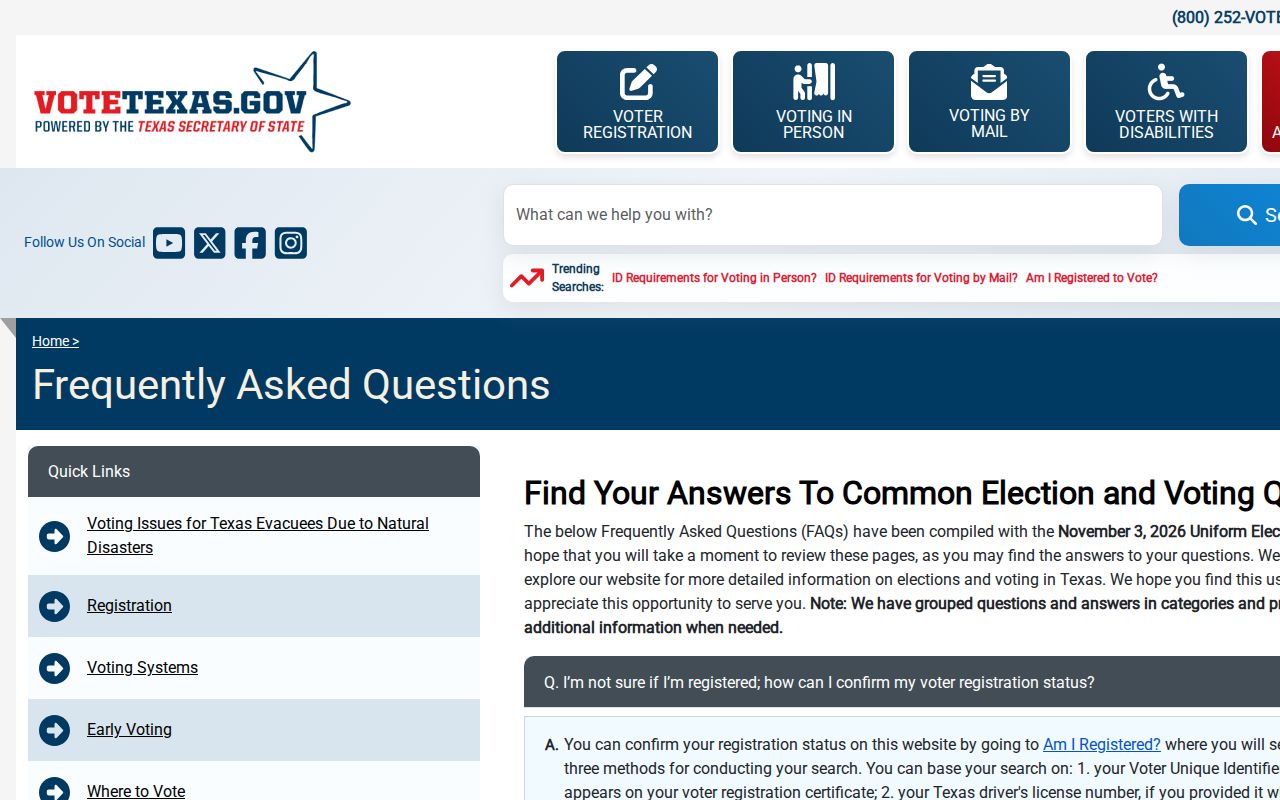
State routes answer status questions. For access beyond a public status screen, the registrar and the statutory request process are the right doors.
Galveston Court Names and Roles
A Galveston court search can surface a party name, role, case number, court, case type, status, filing date, hearings, events, and a disposition where the record is available. The Galveston County Odyssey Portal accepts a record number or a name in Last, First Middle Suffix format. Advanced controls are available. They include location, search type, and an include-cases setting. The statewide re:SearchTX route offers another official court-information path.
County notices tell an older story. The former Tyler public-access system stopped receiving updates and security fixes after December 31, 2025. That explains why an old bookmark fails. Juvenile, sealed, expunged, and otherwise restricted material is not public. A docket result is a court-record lead. It is not a statement of residence.
Note: Record the court, party role, case number, and status before asking a clerk about a copy or a restricted-file boundary.
Galveston Vital Index Access
Texas separates an index lead from a certified record. The custodian is the Department of State Health Services, known as DSHS. Birth records open on the 75th anniversary. Death records open on the 25th. Earlier than that, only a qualified applicant or a person with a direct and tangible interest can obtain the record through the state process. The official applications and forms page names the available forms and request paths.
DSHS provides online, mail, local-registrar, and Austin in-person channels. The original application, a signature or notarization when required, a copy of acceptable identification, and payment all belong in a mail request. Closer to home, the Galveston County Health District is a local route for birth and death records. Ask that office for the current form and coverage.
DSHS request procedures spell out the public-opening dates and the eligibility boundary. An index candidate still needs careful verification.
Galveston Recorded-Name Alerts
The County Clerk runs a free Property Fraud Alert for names appearing on recorded documents. Registration is simple. An owner can list several personal or business names and pick a notification method. It flags a newly filed instrument. That early word beats an unsolicited deed-copy offer.
The alert does not determine title or prove fraud. It also cannot replace a search of the recorded document itself. When an alert arrives, compare the instrument number, parties, recording date, and legal description in the Clerk's official records, and consider a certified copy or professional title advice if an ownership interest is affected.
Historical Galveston Resident Directories
The GTHC holds Galveston city directories spanning 1856 through 2024, a remarkable run for past-residents research. Digitized routes cover 1859 through 1925, with the Rosenberg partner collection especially strong for 1859 through 1881. Microfilm covers 1856 through 1860 and 1866 through 1938. Bound volumes run 1938 to today's range. Telephone directories begin in 1904. These volumes are the best place to look. A printed address or household line often waits inside.
A city directory entry can carry a lot. Look for a name, spouse or widow notation, occupation, business line, street address, room or rear notation, and an owner or renter mark. Copy the entry exactly, record the year and page, then use that volume's abbreviation key. A reverse or criss-cross directory may link an address to a historical occupant, though the exact Galveston reverse-volume runs are not pinned down. Ask GTHC staff for the right volume.
The County Clerk AVA real-property viewer offers another entry point for recorded-property research that pairs well with a directory year.
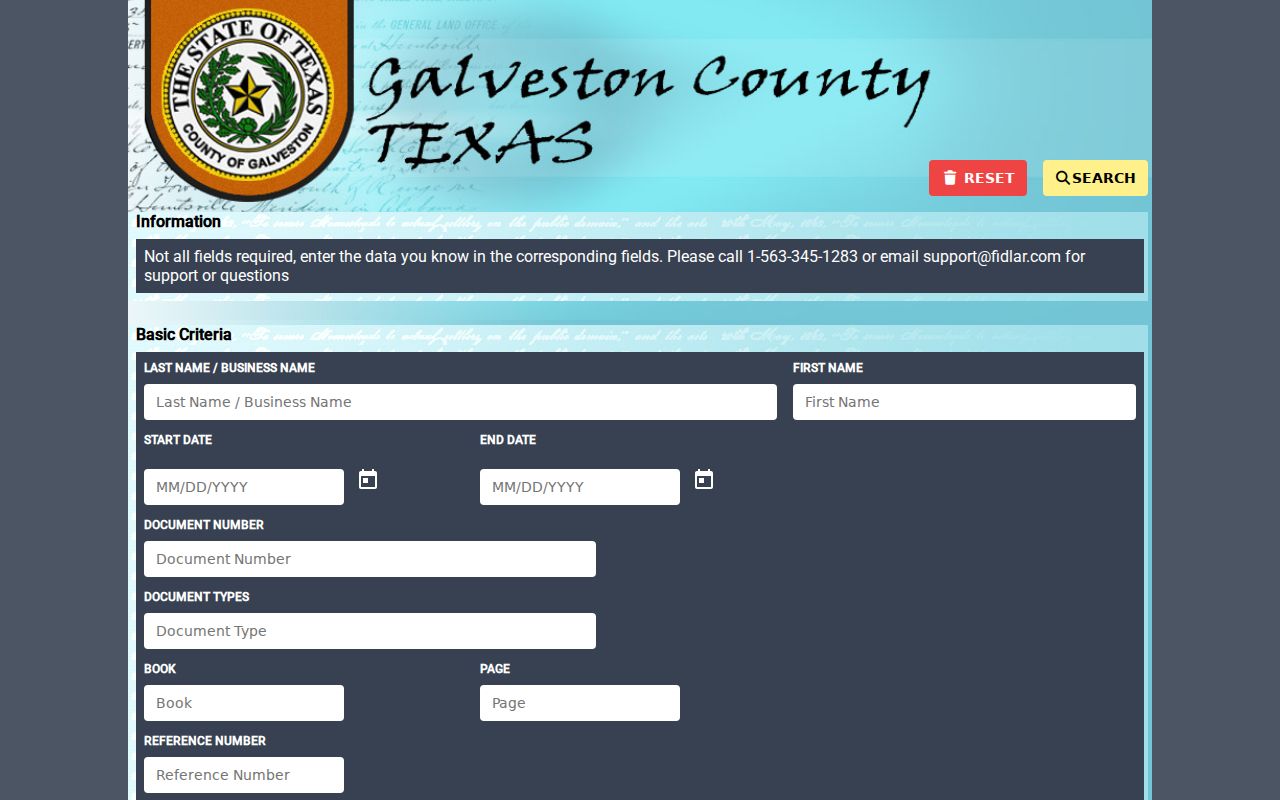
This property viewer bridges names and addresses into recorded real-property research. The historical volumes add the household layer that deeds often lack.
Galveston Storm-Era Household Clues
The 1900 Storm reshapes how any Galveston residents directory line should be read. GTHC puts the death toll above 8,000 across the island and mainland combined. The storm destroyed 2,636 houses. Losses reached an estimated $28 to $30 million. A pre-storm address, a later directory entry, and a current Galveston parcel can describe different structures. Or they describe a household that simply relocated. Verify the lot, block, legal description, and Sanborn map footprint first. Only then call a repeated street address the same house.
Counts from 1900 also disagree. GTHC compares the June 1900 federal census figure of 37,789 with a 1901-02 directory claim of 42,210. Seasonal absence plus different collection methods explain much of the gap. Use the 1899-1900 directory beside the 1900 census rather than letting one replace the other. The recorded-deaths index holds 5,132 names. GTHC cautions it is not a complete casualty count.
Galveston Cemetery Record Changes
Galveston cemetery records entered a new era. In July 2026 the city announced that its IT and GIS teams had digitized cemetery books and handwritten records from the 1900s to the present. The result is a searchable public tool. The announcement did not expose a live tool address. Use the city announcement and the cemetery office route to confirm current access. The project can add burial and family context for directory work. It helps when a person vanishes from a directory.
City-reported work through December 2025 covered 2,711 entries. It also spanned 527 gravesites, 49 lots, 19 sections, two blocks, 2,111 burial-table entries, and three gravestone photos. Cemetery or obituary evidence can flag a death or a family link. But it cannot establish a current Galveston address. It also cannot replace a certified vital record. It cannot substitute for that record.
Galveston Records Requests and Limits
Sometimes no online Galveston record answers the question. Then ask the government body that keeps the record. The Texas Public Information Act, Government Code Chapter 552, lets anyone request public information without stating a reason. Name the record type and the office. Add the date range, address, or case number. The more precise the request, the better. Ask for existing records. A custodian will not create a new report or supply an opinion.
Public information must be released promptly unless exempt. An agency seeking an Attorney General ruling generally must notify the requestor within 10 business days. Fees under Section 552.261 reflect actual reasonable costs, and larger requests can draw an itemized estimate. The Attorney General overview is the statewide starting point for the process.
Note: A narrow request naming the custodian, record series, and date range is easier for a Galveston office to evaluate than a broad demand for every record about a person.
Galveston Property Search Results
GCAD's public eSearch form serves as the official appraisal-district entry point for owner and address searches across Galveston County parcels.
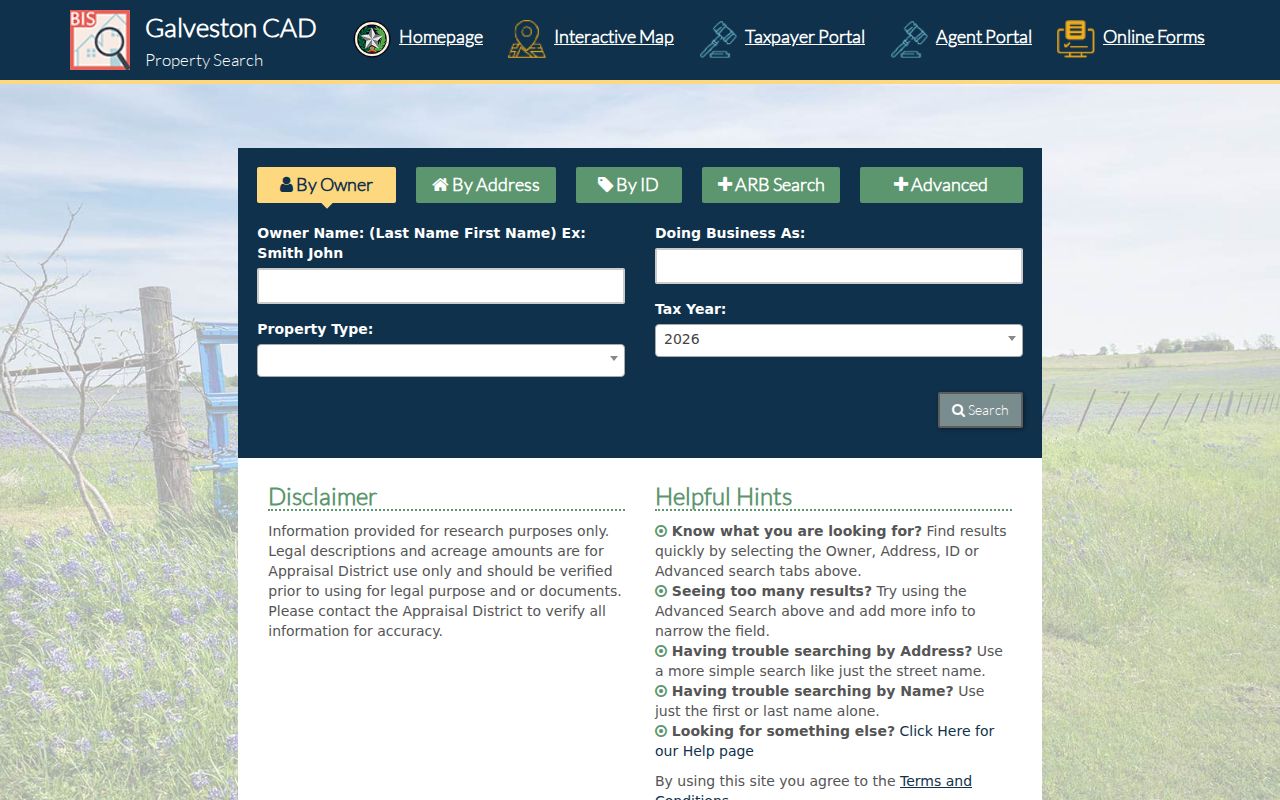
The form offers owner, street, and property-ID paths. Treat owner, mailing recipient, and parcel situs as distinct facts as the search moves toward deeds, maps, and historical Galveston sources.