
Galveston City Directory Collection Runs
The Galveston and Texas History Center, or GTHC, identifies an overall run of Galveston directories from 1856 through 2024. Access depends on the year. Early material has digital routes, while other years require a library card, in-library use, microfilm, or a visit to the reading room. The table separates those paths so a missing result in one channel is not mistaken for a missing volume. Exact publisher-by-volume information was not located in the captured sources, so the printed title page remains the record for a particular edition.
| Collection | Years | Where Held | Access |
|---|---|---|---|
| Galveston city-directory run | 1856-2024 overall | GTHC | Use the year-specific digital, microfilm, or bound-volume route |
| Digitized and online directory subset | 1859-1925 | GTHC and Portal to Texas History | View page images; the Rosenberg partner page is especially documented for 1859-1881 |
| Microfilm directories | 1856-1860; 1866-1938 | GTHC | Reading-room microfilm access |
| Bound directories | 1938-current | GTHC reading room | In-person consultation |
| Telephone directories | 1904-current | GTHC | In-person and collection access; online coverage was not located |
These are collection ranges, not proof that every year is online. Record the title, year, and page used. A library index, a bound volume, and a microfilm reel can each expose different parts of the same historical run.
Galveston City Directories Online and Onsite
For the 1859-1925 online range, the Portal to Texas History is a primary starting point. GTHC also identifies HeritageQuest access with a library card and Ancestry Library Edition in the library for later digitized microfilm. Search the exact year around a known event, then inspect the page image rather than relying on a result label alone. The name index can omit a variant spelling, while a printed page preserves the original punctuation and abbreviations.
The Rosenberg Library partner collection is one documented route to digitized Galveston material and the early directory subset.
The partner collection is useful for locating scanned material, but each displayed page should still be cited by its own volume and page number.
The GTHC city-directories collection explains the split between Portal volumes, library-card resources, and reading-room holdings.
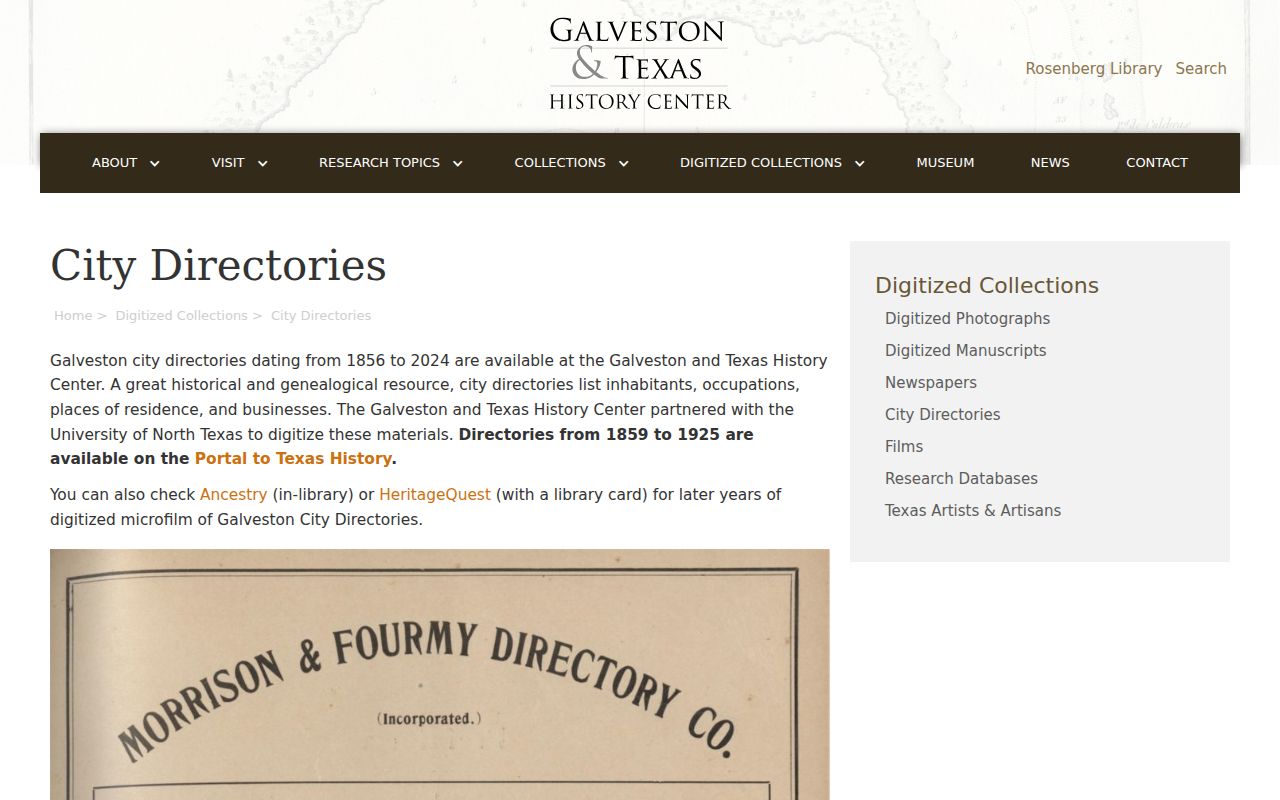
When a year falls outside a visible online set, the microfilm and bound-volume routes keep the search from stopping at a digital gap.
Reading a Galveston City Directory Line
Transcribe an entry exactly as printed before interpreting it. Capture surname and given name, any spouse reference in parentheses, widow notation, the printed activity line, address, room or rear notation, and a separate organization line when one appears. Preserve the directory year and publisher. A line can identify an organization address, a hotel, a rooming entry, or an institution rather than a household, so it does not establish a present-day residence.
| Printed name | Copy the surname, given name, initials, and spelling as shown. |
|---|---|
| Family notation | Record a spouse reference in parentheses or a printed wid notation exactly. |
| Activity line | Keep the printed wording without turning it into a modern conclusion. |
| Address line | Include street number, street name, apartment, room, or rear notation when printed. |
| Status mark | Copy any owner, roomer, or similar notation without expanding it from memory. |
- Criss-cross directory
- A directory arranged by address rather than surname. GTHC holds reverse-directory research material, but the exact Galveston run and years were not separately identified.
- Householder index
- An index designed to point to a household or address entry. Its presence and form vary by volume.
- Abbreviation key
- The explanatory list in a volume's opening pages. Photograph or transcribe it before expanding a shortened mark.
Galveston Directory Abbreviation Checks
The volume's own key controls the reading. Marks that resemble r, res, h, b, or wid can be important, but they should not be expanded from habit. The captured research did not establish a complete Galveston publisher-by-year abbreviation inventory. Treat the introductory pages as part of the source, especially when a short mark affects whether an address is a residence, a room, or a separate line.
A disciplined note has two layers: first the literal transcription, then a clearly labeled interpretation. That separation makes it possible to revisit a conclusion if a later volume uses a different key or spelling. Retain punctuation, number ranges, and all address qualifiers. If the key is missing from a scan, compare only with another copy of the same edition or ask GTHC staff for the volume context.
Trace Galveston Households by Year
Household tracing works best as a sequence rather than a single name match. Start near a known date and follow the same spelling and plausible variants into the prior and next directory. A repeated address, spouse reference, or family detail is stronger than a name alone. The resulting notes can then be compared with census, deed, cemetery, church, probate, and newspaper records without collapsing different people into one file.
- Find the full name and variants in a directory near the target date. Record page, street, and every address line.
- Check the preceding and following volumes. Track address changes, family notation, and printed activity lines.
- Look for an address-ordered or criss-cross volume if the relevant Galveston edition or catalog identifies one.
- Pair 1899-1900 directory material with the June 1900 federal census, then mark the source and date for each fact.
- Use Sanborn maps, deeds, GCAD, newspapers, churches, death records, and probate to test an address bridge.
The most recent public federal census is 1950. Census information describes a household at enumeration, not a continuous address history. If a person disappears from a directory, record the uncertainty rather than choosing among a move, a death, an omission, or a variant name without support.
Galveston Directories and the 1900 Census
GTHC provides a useful warning about 1900. The federal census counted 37,789 Galveston residents in June 1900, while the 1901-02 directory claimed 42,210. The difference is not a reason to reject either source. GTHC points to seasonal absences and differing counting methods, which means each source describes a related but not identical population.
That comparison can also catch a surname variant, a changed street description, or a household missed by one record set. A census provides age, birthplace, and household composition. A directory provides a different date and its own printed address context. Both need their own citation.
Galveston Directory Records After the Storm
The 1900 Storm is a records problem as well as a historical event. GTHC reports that 2,636 houses were destroyed and that historical-society archives suffered damage or loss. Grade raising, rebuilding, relocation, and changing waterfront conditions can break a simple address timeline. A line before the storm and a similar line afterward do not automatically identify the same structure or the same household.
Use a Sanborn sheet, lot or block description, deed, newspaper notice, cemetery or mortuary record, and directory entry together where the evidence permits. The recorded-deaths index lists 5,132 names but is not a complete casualty count. That limitation matters when a person no longer appears in the directories. A missing line should remain a question until several local sources point in the same direction.
Galveston City Directory Archive Companions
The GTHC research databases add newspapers, census routes, maps, manuscripts, photographs, oral histories, church material, and cemetery sources to a directory search. The captured newspaper notes name the Daily Advertiser for 1838-1845 and the Galveston City Bulletin for 1919-1923. Newspapers may supply a social notice, obituary, address, or rebuilding reference, but the exact complete title-and-date matrix was not located.
The GTHC archive catalog connects directory research with manuscripts, photographs, oral histories, and vertical files.
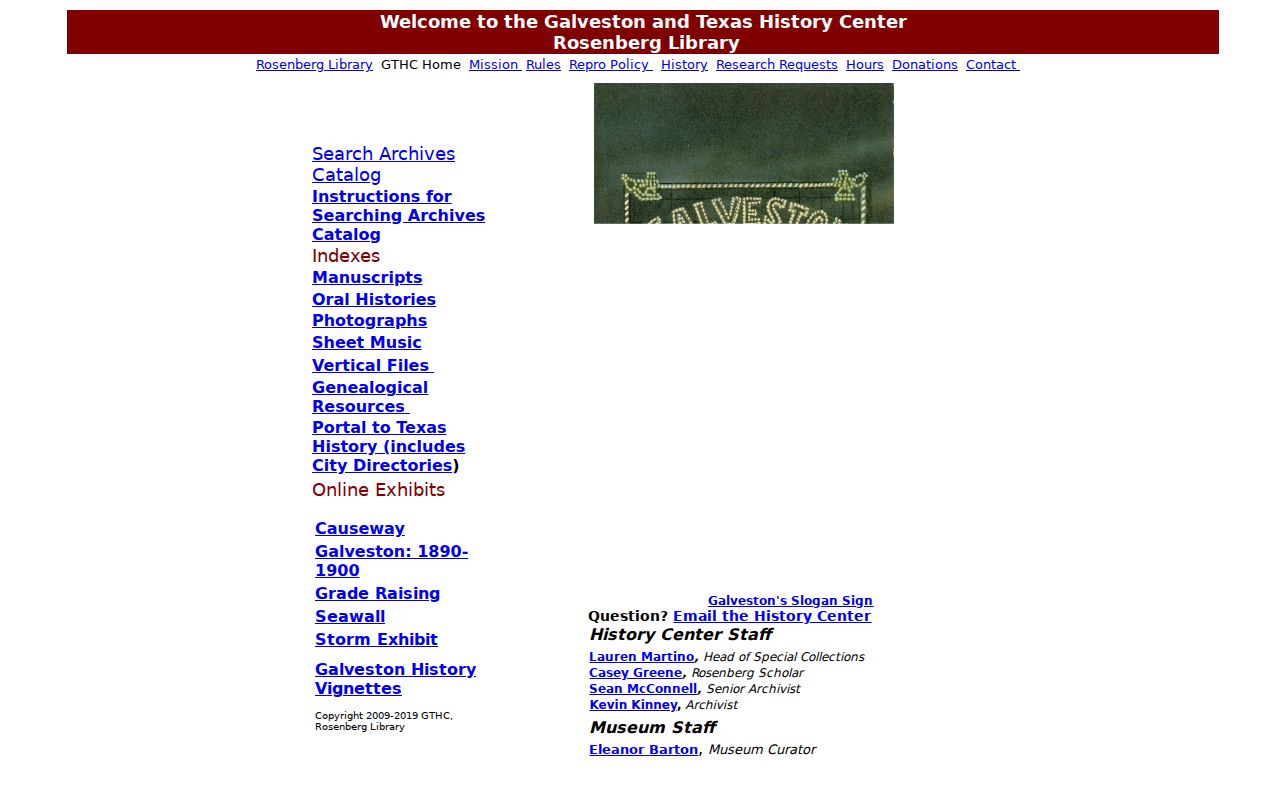
Vertical files include named topics for Galveston City Directory, the Galveston County Genealogical Society, and the Galveston Historical Society, which can help explain a collection gap.
The GTHC genealogy service lists the local historical holdings that can test a directory identification.
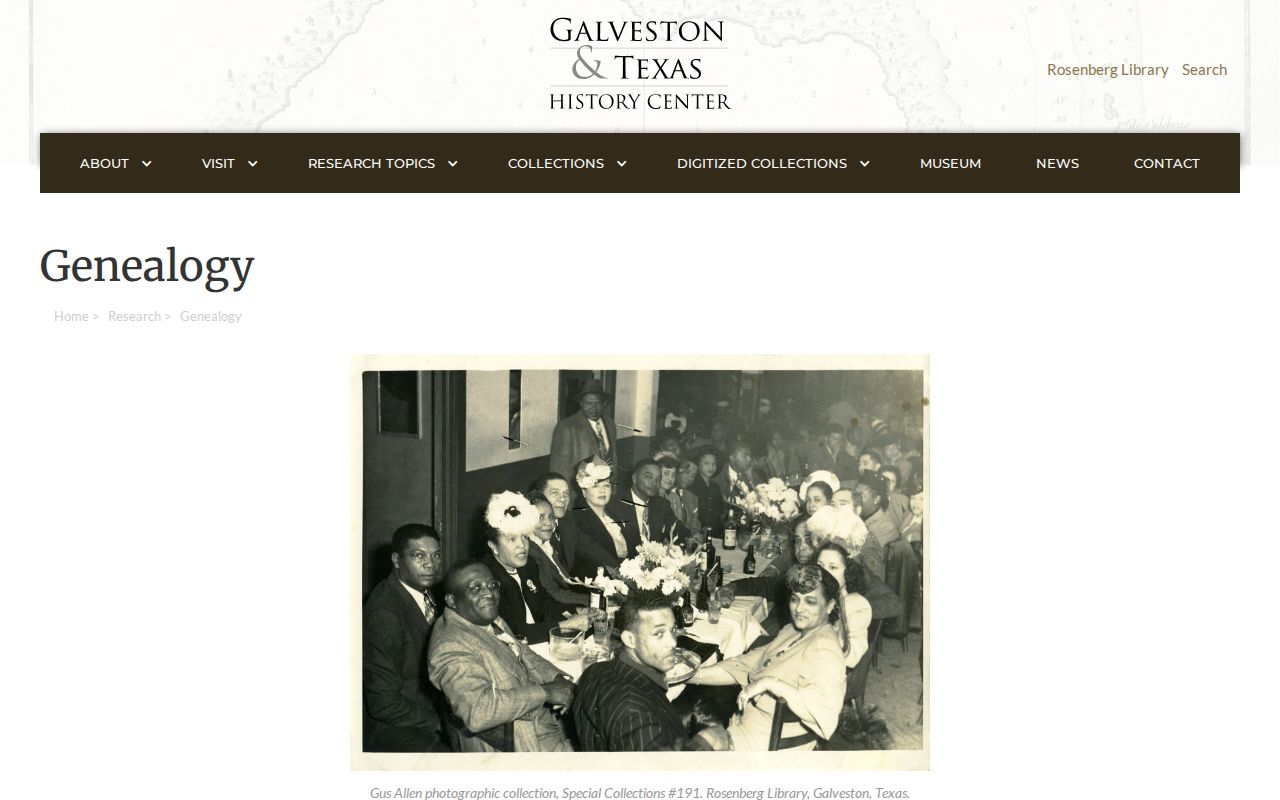
Church registers, cemetery records, tax material, passenger lists, and newspapers are especially useful where a directory name has an alternate spelling or only initials.
Galveston City Directory Research Help
GTHC's reading room is at 2310 Sealy Avenue in Galveston. Captured research lists hours of Tuesday through Saturday, 10 to 5. An archivist can be reached at gthc@rosenberg-library.org or (409) 763-8854 ext. 126. A useful request identifies the name, address, date range, record type, and any volume already checked. That lets staff assess a folder or collection lookup without turning a tentative match into a fact.
Galveston and Texas History Center
2310 Sealy Avenue, Galveston
Tuesday-Saturday, 10-5
(409) 763-8854 ext. 126
gthc@rosenberg-library.org
Research databases
GTHC identifies Portal to Texas History, Newspaper Archives, HeritageQuest, Ancestry Library, Fold3, and in-library FamilySearch affiliate access among its research routes.
For a nineteenth-century gap, the Texas State Library catalog and reading-room route may also hold Galveston County microfilm and historical records. Keep the keeper, collection name, volume, page, and access method in the research notes. Those details make a later verification possible.
GTHC's archive context is particularly useful when a name carries initials, an anglicized form, a married name, or an alternate spelling. Its church holdings include German Lutheran, Jewish, Catholic, Baptist, Presbyterian, and Episcopal material with different date ranges. A directory line should be compared with the relevant register, newspaper, or cemetery source only after the printed form and date have been captured. The historical trail can also include immigration, naturalization, tax, school, funeral, passenger-list, and interment material held through local research channels. Each source answers a narrower question, which is why the exact record type belongs beside every conclusion.