
Galveston Resident Lookup Records
A Galveston resident lookup works best when the record is chosen for the relationship it can actually prove. The county appraisal roll ties a named owner to a parcel, while a recorded instrument ties a grantor or grantee to a legal-description chain. Court and probate indexes identify parties, not present-day residents. Texas voter information is controlled by election law, and vital materials have separate access dates and eligibility rules. Keep the labels precise: owner, mailing recipient, court party, voter registrant, decedent, and heir are not interchangeable descriptions.
| Record | What It Confirms | Where | Access |
|---|---|---|---|
| Parcel and appraisal roll | Owner, situs, mailing destination, parcel context | GCAD eSearch | Public search, subject to confidentiality rules |
| Recorded instrument | Grantor, grantee, legal description, transfer trail | County Clerk Fidlar official records | Public index; image and copy access can differ |
| Voter registration | Status and statutory voter-list information | VoteTexas | Limited by Texas election law |
| Court or probate case | Party role, case status, dates, and docket events | Odyssey | Public cases only; restrictions apply |
| Vital index or record | Candidate event details and family-history confirmation | Texas DSHS Vital Statistics | Indexes and copies follow separate rules |
Start with GCAD when an owner name or property address is known. Use the County Clerk instrument index when the question is about a transfer or legal description. A court or probate record is useful for a named role and case history, while DSHS material is a careful identity cross-check rather than a shortcut to a current address.
Galveston Owner Record Search
GCAD eSearch accepts an owner name, street number and name, property ID, Geographic ID, subdivision, neighborhood, condominium, tax year, and other appraisal filters. Record the situs address separately from the mailing address. The situs is the physical parcel location; the mailing address is where tax correspondence goes. Either can differ from a person’s present location. A homestead exemption is an appraisal-context signal, not proof that someone is there today.
For a stronger match, carry the owner name, Geo ID, legal description, and recorded deed date into Fidlar or the County Clerk’s AVA real-property viewer. Search the owner as grantee around the deed date, then confirm that the legal description matches the parcel. A trust, estate, business, or attorney-in-fact may appear on an instrument, so a deed party should not be labeled an occupant without separate support.
Note: A name in GCAD is useful for a property relationship, but it needs another independent record before it resolves a same-name match.
Verifying a Galveston Resident
Use a two-source rule before saying a Galveston name search identifies the right person. Common surnames, repeated family names, historic directory entries, and entity ownership can all create false matches. A repeated address, distinctive middle name, spouse or relative, event date, or clear document role is a better bridge than a phone number or date of birth. Avoid using intrusive fields when the name and record role answer the question.
- Search GCAD by the full name and save the situs, mailing destination, Geo ID, and legal description that appear on the parcel record.
- Use the County Clerk index to locate a deed connected to that name, then compare its legal description and role with the appraisal record.
- Check Odyssey or probate only for a matching party role, court, date, and case number. A case party may not live in Galveston County.
- Use a DSHS index, eligible verification, obituary, cemetery entry, or probate filing to confirm an event or family connection when that is necessary.
- Request a certified copy from the responsible custodian only when the record type and eligibility rules permit it.
- Docket
- A court’s running case record, which can list events, hearings, filings, and orders.
- Index versus image
- An index points to a record by name, number, or date. The underlying scanned document may have different viewing or copy rules.
- Certified copy
- A copy issued by the record custodian with its certification, when that office allows the request.
Galveston Court Search Fields
For a name-based court check, Galveston County Odyssey Smart Search asks for a record number or a name in Last, First Middle Suffix form. The available person fields are last name, first name, middle name, and suffix. Advanced controls include location, search type, and include cases. Party Search offers Party Name, Nickname, Business Name, and Sounds Like. Use the narrowest ordinary name search that fits the question instead of collecting extra identity data.
| Result detail to record | Why it matters |
|---|---|
| Case or record number and court | Lets the clerk locate the correct file. |
| Party name and role | Separates a petitioner, respondent, heir, or other participant. |
| Case type, status, and filing date | Places the result in a time and case context. |
| Judicial officer, hearing, and docket event | Shows the procedural record where visible. |
| Document link, disposition, or redaction note | Shows whether a public item is available and what it does not reveal. |
See the Odyssey Smart Search entry screen before entering a name.
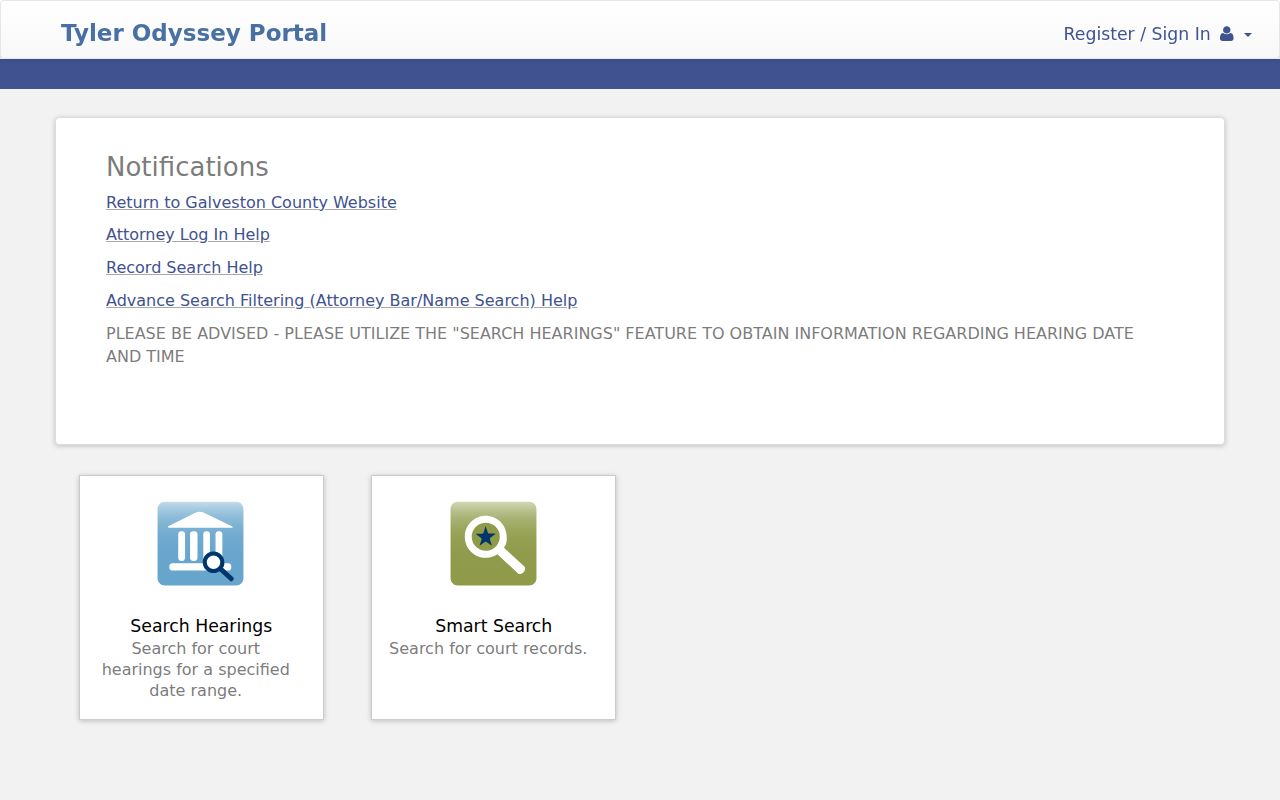
Odyssey requires JavaScript and cookies. Exact dropdown values and result pagination were not captured, so record only fields actually visible in a lawful result. Juvenile, sealed, expunged, adoption, and protected family-law information are not ordinary public-search material.
Galveston Court Search Routes
Odyssey covers the local County Courts at Law and Probate Court route, while re:SearchTX is the statewide court-information route named in the county’s migration notice. The old Tyler public-access system stopped receiving updates and security fixes after December 31, 2025. County guidance directs users to Odyssey or re:SearchTX for current essential party and case information. Coverage and field availability can vary, so confirm a result with the County Clerk or District Clerk.
The Texas re:SearchTX portal is the state route identified in the county notice.
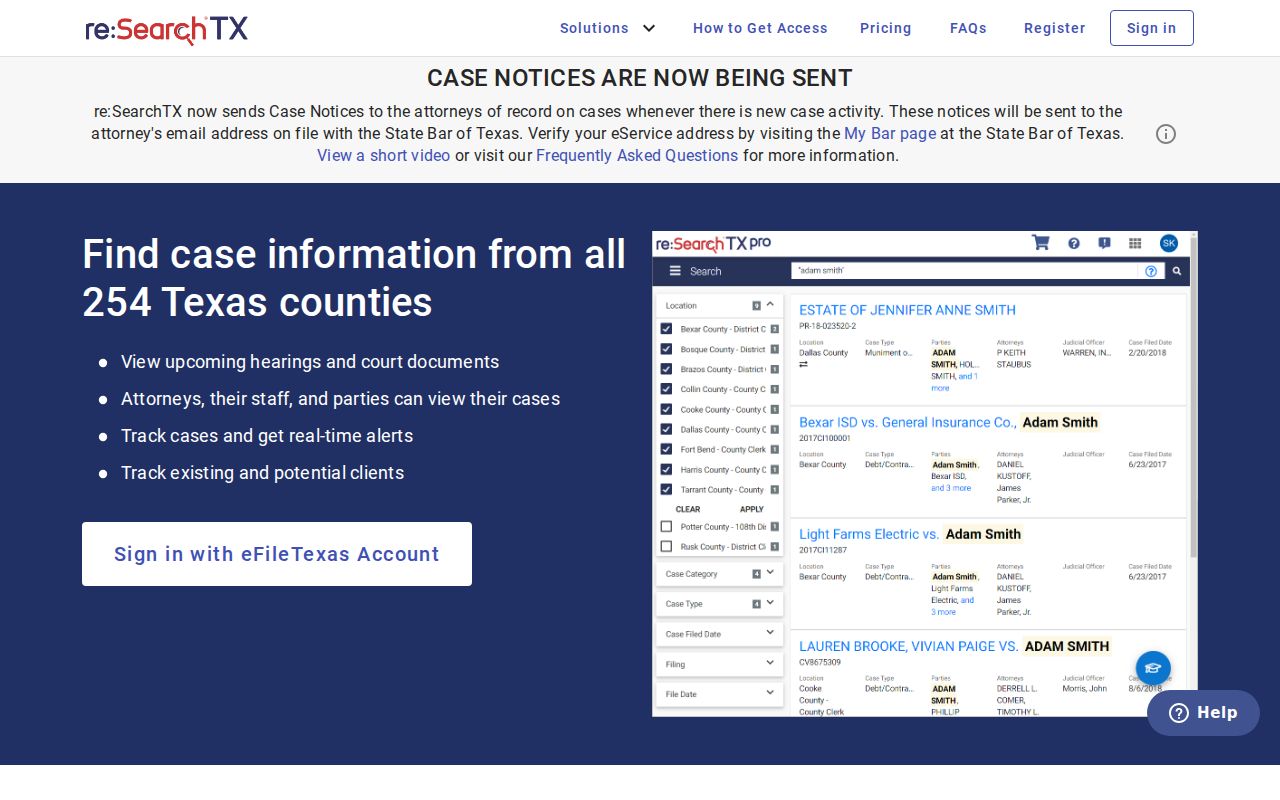
Its participating-case coverage can vary by court and county. Treat it as a way to confirm a case trail, not as proof of a current address.
A needed document may require a separate request. The District Clerk copy request is for previously filed District Clerk documents and cannot create a report or list of cases. The County Clerk’s historical copy route asks for the case number, style, document name, certified or non-certified choice, copies, payment, and delivery method. Clerk staff can explain whether a series exists and how to request a public item, but they cannot make an unsupported identity determination.
Note: Probate can identify a representative or heir in a case, yet that role alone does not establish a present address.
Galveston Vital Record Checks
Texas DSHS provides a careful cross-check when identity turns on a life event. Birth records become public on the 75th anniversary, and death records on the 25th anniversary. Before those points, the record subject, eligible family, a guardian or legal representative, or a person with documented direct and tangible interest must qualify. Downloadable birth indexes begin in 1925 and death indexes in 1965; earlier microfiche starts in 1903. A candidate index entry is not the same as a certified record.
DSHS accepts eligible requests through Texas.gov, mail, local registrar service, or Austin in-person service. Mail requires the original application, signature or notarization where required, an acceptable ID photocopy, and payment. In-person requests require original ID and payment. For a Galveston event, a local birth and death-record route exists, though its exact local historical cutoff and fee schedule were not captured. DSHS lists a $20 marriage or divorce verification when that narrow confirmation is appropriate.
The City’s July 10, 2026 cemetery announcement says its IT and GIS staff digitized books and records from the 1900s to the present.
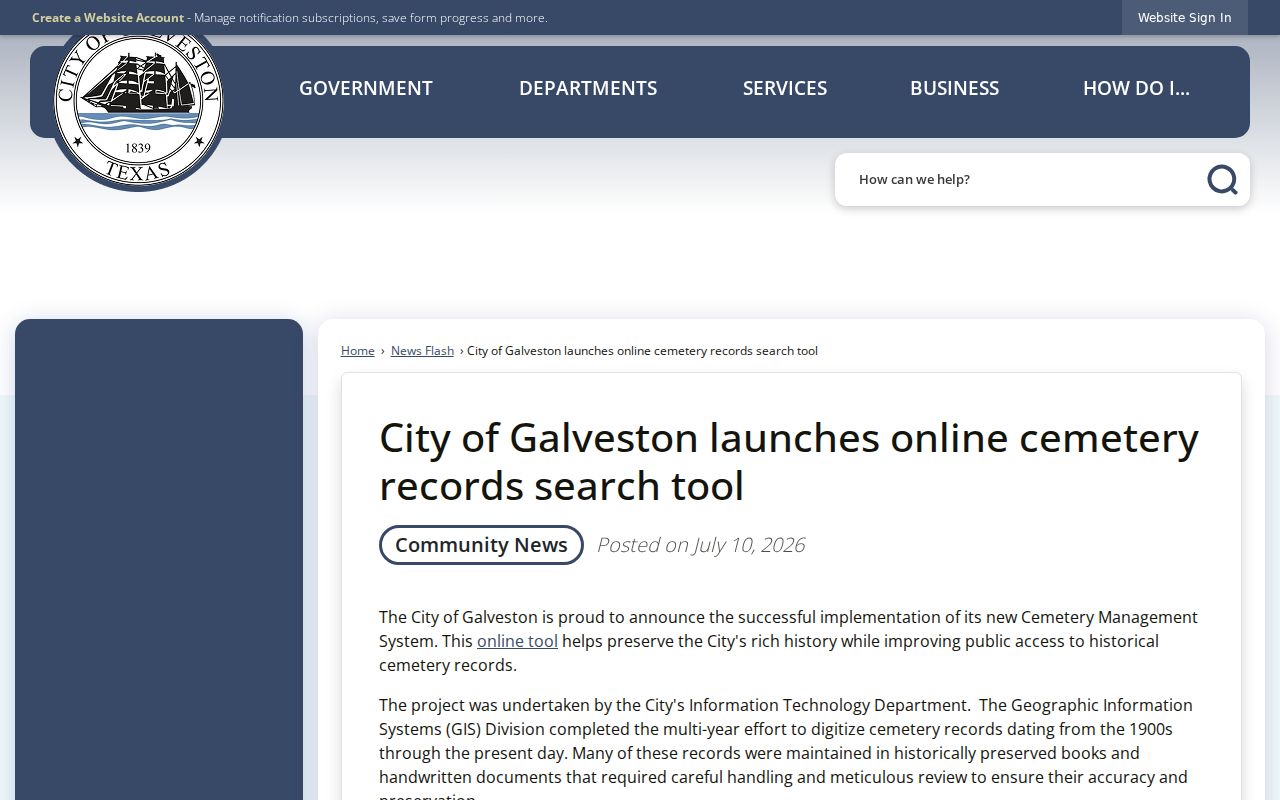
The announcement describes a searchable public tool but did not give a live search URL. Cemetery and interment material can support a death or burial lead; it is not a certified death record or a current-address source.
Galveston Voter Record Limits
VoteTexas offers status-lookup routes using a VUID, a supplied Texas driver-license number, or name-based information under its official guidance. A suspense status means the address is uncertain or mail was returned. It is not a criminal finding. Texas does not register voters by political party, and voting history does not reveal ballot choices. Registration information concerns election records, not a broad proof of current occupancy.
For a statutory public voter-list request, use the Secretary of State’s public-information form through the lawful county or statewide process. Texas Election Code sections 18.066 and 18.067 set request, exclusion, fee, affidavit, and use limits. Section 13.004 protects sensitive registration information. Protected-address records must stay protected, and no person should attempt to reconstruct a substitute address from other sources.
Note: A lawful voter record can confirm election-record status, but it cannot prove present occupancy or reveal a person’s ballot choices.
Galveston Record Requests
When an official search ends, make a narrow request for an existing record rather than asking an office to create a person-by-person report. Under the Texas Public Information Act, a requester need not explain why, but the request should identify the record series, address or name, and date range. A custodian can confirm whether a record exists, what it costs, and whether an exception applies. The law does not set one universal production deadline.
Ask for an itemized estimate when a request could exceed ordinary costs. The research notes that a governmental body generally must notify a requester within 10 business days if it seeks an Attorney General ruling. For archival questions, the Galveston and Texas History Center can be asked for a collection or folder lookup using a name, address, date range, and record type. That route is especially useful when a historical directory, obituary, or neighborhood file explains a record that has no public search box.
Galveston Resident Lookup Privacy Limits
Texas law keeps key information out of a routine name search. The Address Confidentiality Program can provide a substitute mailing address in qualifying safety circumstances. Government Code sections 552.117 and 552.1175 protect qualifying home, phone, and family details. Tax Code sections 25.026 and 25.027 add appraisal-record limits, and the federal DPPA does not allow a public-record search to become a path to DMV information. Respect a custodian’s redaction and correct an error at the original office before asking a private controller to change copied material.
Lawful use. Use Galveston records for personal, lawful research, family history, civic questions, or estate matters. Texas Penal Code sections 42.072 and 42.07 address stalking and harassment; never use a public record to monitor, intimidate, or harm another person.